Most people working in sustainability have heard of ISO 14040 and ISO 14044. Fewer can explain what they actually require, and what they leave deliberately open to interpretation.
That gap matters. Because if you are commissioning or conducting a life cycle assessment, the standards that govern it shape everything: what counts as valid, what can be compared, and what claims you are allowed to make.
What ISO 14040 and ISO 14044 are
ISO 14040 and ISO 14044 are the two international standards that define how a life cycle assessment must be conducted. Together, they form the foundation of every credible LCA.
ISO 14040 sets out the principles and framework. It defines what a life cycle is, describes the overall structure of the LCA process, and establishes the core concepts practitioners need to work with.
ISO 14044 goes deeper. It specifies the requirements and guidelines for each phase of an LCA: how to define goals and scope, how to collect and structure inventory data, how to conduct the impact assessment, and how to interpret and report results.
The two standards are complementary. ISO 14040 tells you what LCA is. ISO 14044 tells you how to do it.
"LCA is one of several environmental management techniques (…) and may not be the most appropriate technique to use in all situations."
Both were originally published in 1997 as part of a four-standard series (ISO 14040, 14041, 14042 and 14043). They were revised in 2006 and consolidated into the current two-standard structure. The core technical content remained unchanged. The revision focused on improving readability and removing inconsistencies, while adding important clarifications around comparative assertions, system boundaries and critical review.
The four phases of an LCA
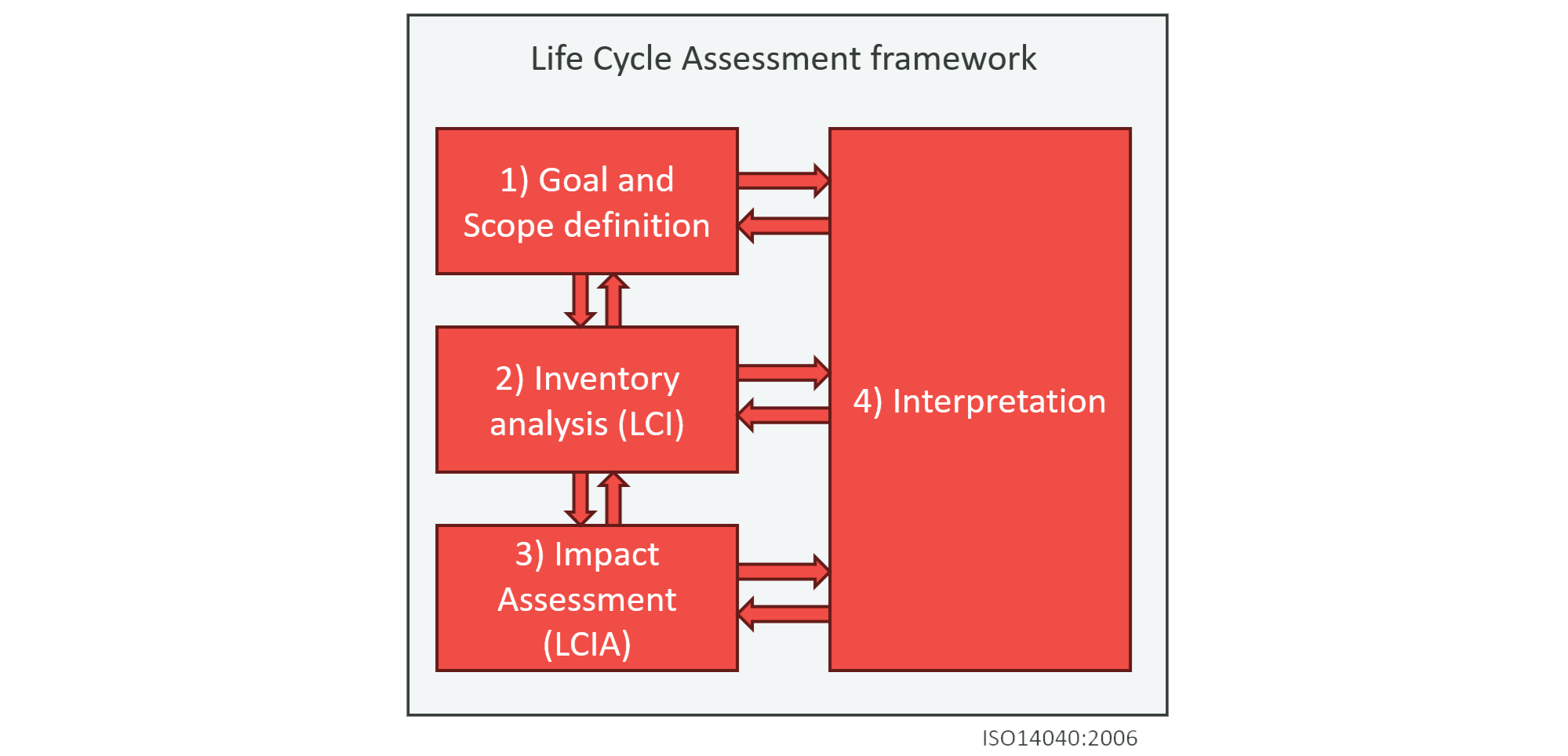
ISO 14044 structures every LCA into four phases. These are not sequential steps in a straight line. They interact, and good LCA practice means moving between them as understanding of the system develops.

Phase 1: Goal and scope definition
This is where the study is set up. The goal must state why the LCA is being conducted, what it will be used for, and who the intended audience is. The scope defines the product system, the functional unit, the system boundary, and the impact categories to be assessed.
Getting this phase right determines the usefulness of everything that follows. An LCA that does not clearly state its intended application cannot be evaluated against that application. This is not a formality. It is the foundation of the work.
ISO 14044:2006, clause 4.2.2
"In defining the goal of an LCA, the following items shall be unambiguously stated the intended application, the reasons for carrying out the study, the intended audience, i.e. to whom the results of the study are intended to be communicated, and whether the results are intended to be used in comparative assertions intended to be disclosed to the public."
Phase 2: Life cycle inventory analysis (LCI)
This is the data collection phase. Every input to and output from the system, across its entire life cycle, is quantified here. Raw materials, energy, transport, emissions to air and water, waste: all of it.
The inventory is the most time-intensive part of any LCA, and where the quality of the result is ultimately decided. ISO 14044 provides guidance on data quality requirements, how to handle data gaps, and how to document sources and assumptions.
In practice, practitioners distinguish between the foreground system and the background system. The foreground system covers the processes you model explicitly, usually based on primary data from the client or your own measurements. The background system covers everything else, drawn from a background database such as ecoinvent, EXIOBASE or bonsai. This distinction is not defined in ISO 14044, but it is a useful transparency convention: it makes clear which parts of the model you have direct control over and which parts rely on average or proxy data.
One area where completeness is often underestimated is capital goods and services: the machinery, buildings, infrastructure, maintenance, and administration that support production. These are rarely provided in client data, but they can contribute meaningfully to total impact depending on the sector.
Phase 3: Life cycle impact assessment (LCIA)
Here the inventory data is translated into environmental impact categories: climate change, land use, water use, toxicity, and others. This is done by classifying which emissions and resource flows belong to which categories, then characterising them using agreed factors.
ISO 14044 also allows for optional steps: normalisation (comparing results against a reference value) and weighting (assigning relative importance to different impact categories). These steps involve value choices, which is why the standard treats them as optional rather than mandatory.
Phase 4: Interpretation
The final phase connects results back to the original goal and scope. It includes identifying significant issues, checking completeness and consistency, conducting sensitivity analysis, and formulating conclusions, limitations and recommendations.
Interpretation is not a single step at the end. ISO 14044 requires it to run iteratively alongside the other phases. What you find in the inventory analysis may require you to revisit your scope. What you see in the impact assessment may require you to go back and collect better data.
ISO 14044:2006, clause 4.2.1
"Due to the iterative nature of LCA, the scope may have to be refined during the study."
What the standards actually require
ISO 14044 specifies a number of requirements that any LCA claiming compliance must meet.
Co-products and allocation
When a process produces more than one output, the environmental burden must be distributed across those outputs. ISO 14044 establishes a clear hierarchy for handling this. The preferred approach is to avoid allocation altogether, either by subdividing the process into smaller unit processes, or by expanding the product system to include the additional functions of co-products. Allocation by physical or economic relationships is permitted, but only where system expansion is genuinely not possible.
This hierarchy is more than a technical preference. It reflects a scientific principle: physical mass and energy balances are maintained in a consequentially modelled system in a way that allocated systems cannot achieve.
ISO 14044:2006, clause 4.3.4.2
“Wherever possible, allocation should be avoided by dividing the unit process to be allocated into two or more subprocesses and collecting the input and output data related to these subprocesses or expanding the product system to include the additional functions related to the co-products (…) The inventory is based on material balances between input and output. Allocation procedures should therefore approximate as much as possible such fundamental input-output relationships and characteristics.”
Comparative assertions
Any LCA used to make comparative claims intended for public disclosure must undergo an independent critical review. This is not optional. If a company wants to say that product A is better than product B, and they want to say that publicly, the study supporting that claim must be reviewed by a panel of independent experts.
Transparency
Every significant methodological choice must be documented. Data sources, assumptions, cut-off criteria, allocation decisions, sensitivity results: all of it must be reported in enough detail that an independent reviewer can evaluate the work.
"The results, data, methods, assumptions, and limitations shall be transparent and presented in sufficient detail to allow the reader to comprehend the complexities and trade-offs inherent in the LCA."
Scope: cradle-to-grave
To call a study an LCA, it must cover the full life cycle from raw material extraction to end of life. Studies covering only part of the life cycle (for example, cradle-to-gate or gate-to-grave) are LCA modules, not full life cycle assessments. The distinction matters when interpreting and communicating results.
Comparing results across studies
Two LCA results from different studies cannot be directly compared, even if both claim ISO compliance. Different background databases, system boundaries, cut-off rules, allocation methods, and data quality choices all affect the result in ways that are invisible unless the full methodology is disclosed. ISO 14044 is explicit: comparative assertions intended for public disclosure must be based on a single study covering both systems under comparison. Using one study's result for product A and another study's result for product B is not a valid comparison.
What the standards leave open
ISO 14040 and 14044 are framework standards. They define the structure and the minimum requirements. They do not prescribe which impact assessment method to use, which background database to draw from, or how to identify marginal suppliers in a consequential model.
This is intentional. The standards are designed to be applicable across all sectors and all types of LCA questions. Sector-specific guidance, where needed, is provided by application standards and product category rules that build on the ISO 14040 foundation.
It also means that two studies both claiming ISO compliance can differ significantly in methodology and result. The standard does not prevent this. What it requires is that every significant choice is documented and justified.
The standards and consequential LCA
ISO 14040 and 14044 were published before the terms attributional and consequential LCA had been formally defined. The word attributional was not coined until 2001. The distinction was not defined in an international guideline until 2011.
Yet the standards consistently support a consequential interpretation.
The introduction to ISO 14040:2006 lists the applications of LCA. Every one of them is about improvement and decision-making: identifying opportunities to improve environmental performance, informing decision-makers for strategic planning and product design, supporting marketing and ecolabelling.
The 2006 revision also added an annex to ISO 14040 that goes further. It states directly that the products and processes studied in an LCA are those affected by the decision that the LCA intends to support. That is the language of consequential modelling. The annex then acknowledges that a different approach has since developed — one that assigns elementary flows and potential environmental impacts to a specific product, typically as an account of the history of the product. That is attributional LCA. The standard does not endorse this approach. It notes its existence. The framing makes clear which came first.
ISO 14040:2006; Annex A.2
“applications relate to decisions that aim for environmental improvements, which is also the overall focus of the ISO 14000-series. Therefore, the products and processes studied in an LCA are those affected by the decision that the LCA intends to support”
The principle of priority of scientific approach, stated in clause 4.1.8, holds that decisions within an LCA should be based on natural science first. Where no scientific basis exists, other approaches or international conventions may be used. Normative value choices, such as those required for allocation in attributional LCA, are explicitly the last resort.
ISO 14040:2006, clause 4.1.8
"Decisions within an LCA are preferably based on natural science. If this is not possible, other scientific approaches (e.g. from social and economic sciences) can be used or international conventions can be referred to. If neither a scientific basis exists nor a justification based on other scientific approaches or international conventions is possible, then, as appropriate, decisions may be based on value choices."
The allocation hierarchy, described above, places system expansion at the top. This is the foundation of consequential modelling.
ISO 14049, referenced in the allocation clause, goes further. It describes system expansion in terms that are unmistakably consequential: identifying whether market production fluctuates or is constant, identifying which suppliers are constrained and therefore not relevant, and identifying the marginal supplier whose output will change in response to a change in demand.
The standards do not use the word consequential. But the logic they require, when followed rigorously, leads there.
Marginal and incremental modelling
Two types of change require different modelling approaches. A small-scale change is one that does not affect the determining parameters of the overall market: the direction of the trend, the constraints on production, or the costs of the technologies involved. These changes can be modelled using marginal suppliers and marginal technologies. A large-scale change, by contrast, shifts one or more of those parameters. It changes market direction, removes or creates constraints, or alters production costs. This requires incremental modelling: tracing the path between the system's state before the change and its state after.
Only marginal changes can currently be modelled systematically in an LCI database. In a marginal situation, the same technologies are affected regardless of whether demand increases or decreases, which makes systematic database construction possible. Incremental changes must be modelled individually, case by case, because the shape of the change cannot be predicted in advance.
This distinction matters even for small decisions. A single purchase sends a market signal that, aggregated with other purchases, influences production investment. The consequential question is not whether any individual choice visibly moves the market — it usually does not — but whether the model correctly captures the causal chain between decision and consequence.
How ISO 14040 and 14044 relate to other standards
ISO 14040 and 14044 are the foundation. A number of other standards and frameworks build on them for specific purposes.
ISO 14067 provides requirements for calculating a product carbon footprint using LCA data.
ISO 14064 covers greenhouse gas accounting at both organisational and product level.
The GHG Protocol is not an ISO standard, but it draws heavily on LCA principles and explicitly references ISO 14044 in its guidance on avoided emissions and system boundaries.
Sector-specific Product Category Rules (PCRs) provide detailed instructions for LCAs within particular industries. These rules must be consistent with ISO 14040 and 14044.
When a consultancy or company claims their LCA is ISO-compliant, it means the study meets the requirements set by ISO 14044. It does not automatically mean it complies with any of these application-specific standards. That depends on what the study is intended to be used for.
Why compliance matters, and where it reaches its limits
ISO compliance gives an LCA credibility. It means the study followed a recognised framework, documented its choices, and can be evaluated by a reviewer who knows what to look for.
But compliance is a threshold, not a guarantee of quality. Two studies can both be ISO-compliant while reaching opposite conclusions, because the standards allow significant latitude in methodological choices. Functional unit definition, background database selection, handling of co-products, treatment of land use change: all of these can be done in ways that are technically compliant but produce very different results.
This is why transparency is not just a compliance requirement. It is the mechanism that makes an LCA result trustworthy or questionable. A number without an explanation of the assumptions behind it tells you very little. A number with full documentation of those assumptions tells you what the result actually means and what it does not.
The standard requires transparency. How thoroughly practitioners apply it varies enormously.
Limitations of LCA as a method
ISO 14040 and 14044 provide a rigorous framework, but LCA is not an exact science. Understanding the method's limitations is part of using it well.
Database delays
Background databases are built from historical data and take years to compile. There is usually a significant gap between the year a database reflects and the year a study is conducted. No database is continuously updated in real time, which means results for rapidly changing sectors (energy systems, for example) should be interpreted with care.
Uncertainty in future scenarios
When LCA is used to support prospective decisions, additional uncertainty arises. Identifying marginal suppliers, modelling market trends, and projecting technology change all involve assumptions about how the world will develop. This uncertainty can be managed through sensitivity analysis and scenario modelling, but it cannot be eliminated.
Person-specific assumptions
Even when two practitioners follow the same methodology, their results may differ because LCA requires numerous expert judgements. Functional unit definition, choice of proxy processes, treatment of co-products, and handling of data gaps all introduce variation. This is why transparency is not just a reporting requirement. It is the only mechanism that allows results to be evaluated, challenged, and improved.
Non-quantifiable aspects
LCA works well for biophysical impacts that can be measured and modelled. It is harder to apply to aspects that are not easily quantifiable, such as biodiversity at the local level, social impacts, or the signal value of a purchasing decision. Work in these areas is ongoing, including in social LCA and methods for assigning value to non-market goods, but they remain less mature than conventional biophysical LCA.
There is no perfect LCA
Every LCA involves trade-offs between completeness, data quality, time, and cost. There is no single correct way to do an LCA, and results always depend on methodological choices. What this means in practice is that a well-documented study with known limitations is more useful, and more trustworthy, than one that claims completeness it cannot demonstrate.
What can and cannot be verified
A complete LCA system cannot be verified against the world, because the system being modelled is essentially the world. What can be verified are individual data points and individual model elements. Every step in a well-constructed model has a cause-and-effect relationship that can be checked and challenged.
What cannot be verified is a normative choice. An allocation factor is a value judgement, not a physical fact. It cannot be shown to be correct or incorrect. This is one of the scientific reasons why system expansion is preferable to allocation: it replaces a normative element with a verifiable causal chain. A study built on system expansion can be scrutinised step by step. A study built on allocation factors cannot.
Working within the standards
At 2-0 LCA, we conduct LCAs in accordance with ISO 14040 and ISO 14044. We also go further than the standards require in areas where we believe the science demands it: consequential modelling, full system expansion for co-products, inclusion of indirect land use change, and thorough sensitivity and uncertainty analysis.
When clients need results that comply with application-specific standards such as the PEF scheme, we deliver those as well. But we treat the standards as a floor, not a ceiling.
The goal is always the same: results you can stand behind, decisions you can make with confidence, and data that tells you not just what the impact is, but what to do about it.
Our LCA services
Contact our Specialist
Jonas Eliassen
Life Cycle Specialist
Get in touch