


Biomass is often considered a climate-neutral fuel because the carbon emitted during combustion is the same carbon that was absorbed from the atmosphere during the biomass's growth. As a result, biomass may appear carbon neutral at first glance. In reality, the issue is not that simple, as several other factors must be considered, including temporal aspects, land use changes, and different types of biomass including residues.
We have made this case before, including in Jannick Schmidt's presentation to the parliamentary hearing on biomass. The logic runs in three steps.
When we call biomass climate-neutral, we assume that the carbon released when we burn it is the same carbon the forest absorbed while growing. Over a long enough time horizon, the carbon balances.
The problem lies in the time gap between emission and reabsorption. When a tree is harvested and burned, the CO₂ is released into the atmosphere immediately, whereas the forest takes several decades to reabsorb an equivalent amount of carbon. During this period, the additional CO₂ in the atmosphere contributes to global warming.
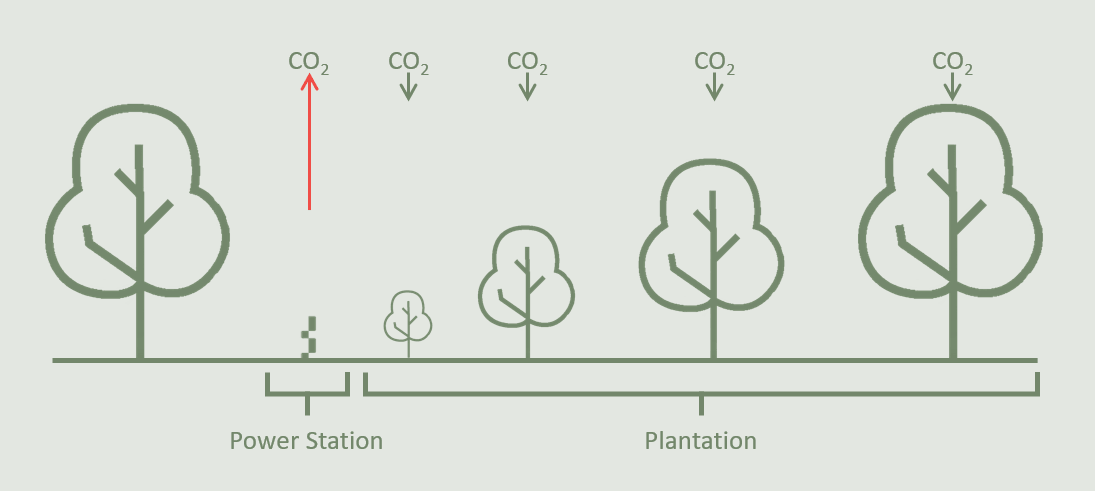
This timing is precisely what matters. The most rapid increase in global temperatures is occurring now, meaning that any additional acceleration of global warming creates further challenges as both economy and ecosystems, including plant and animal species, struggle to adapt to rapidly changing climatic conditions. Consequently, a CO₂ emission released today and reabsorbed only decades later can never be considered impact-neutral, as the intervening period of elevated atmospheric carbon contributes to warming and its associated effects.
On top of that, harvesting, transport, replanting and the land itself all carry emissions of their own. So even in the best case, biomass is lower impact. From a life-cycle perspective, biomass can never be truly climate-neutral.
Biomass can be divided into two overall categories: Biomass with higher climate impact and biomass with lower climate impact.
High-impact biomass production requires land. Consider the addition of one hectare of energy crops: that land must be sourced from somewhere, and it is often already in use for purposes such as food production. When introducing energy crops, where other crops would else have been grown, displaces these other crops, and they will reappear elsewhere to satisfy food or other demand. Meeting this demand may require the conversion of forests or other natural ecosystems into productive land, a process which according to IPCC corresponds to approximately 11% of global GHG emissions. Alternatively, production may be intensified on existing farmland to increase yields, which can also generate additional emissions through greater use of fertilisers. These effects are known as indirect land-use changes (iLUC), and their impacts often occur beyond national borders compared to where the bionmass is used or produced. Land is a resource, and its climate implications cannot be ignored.
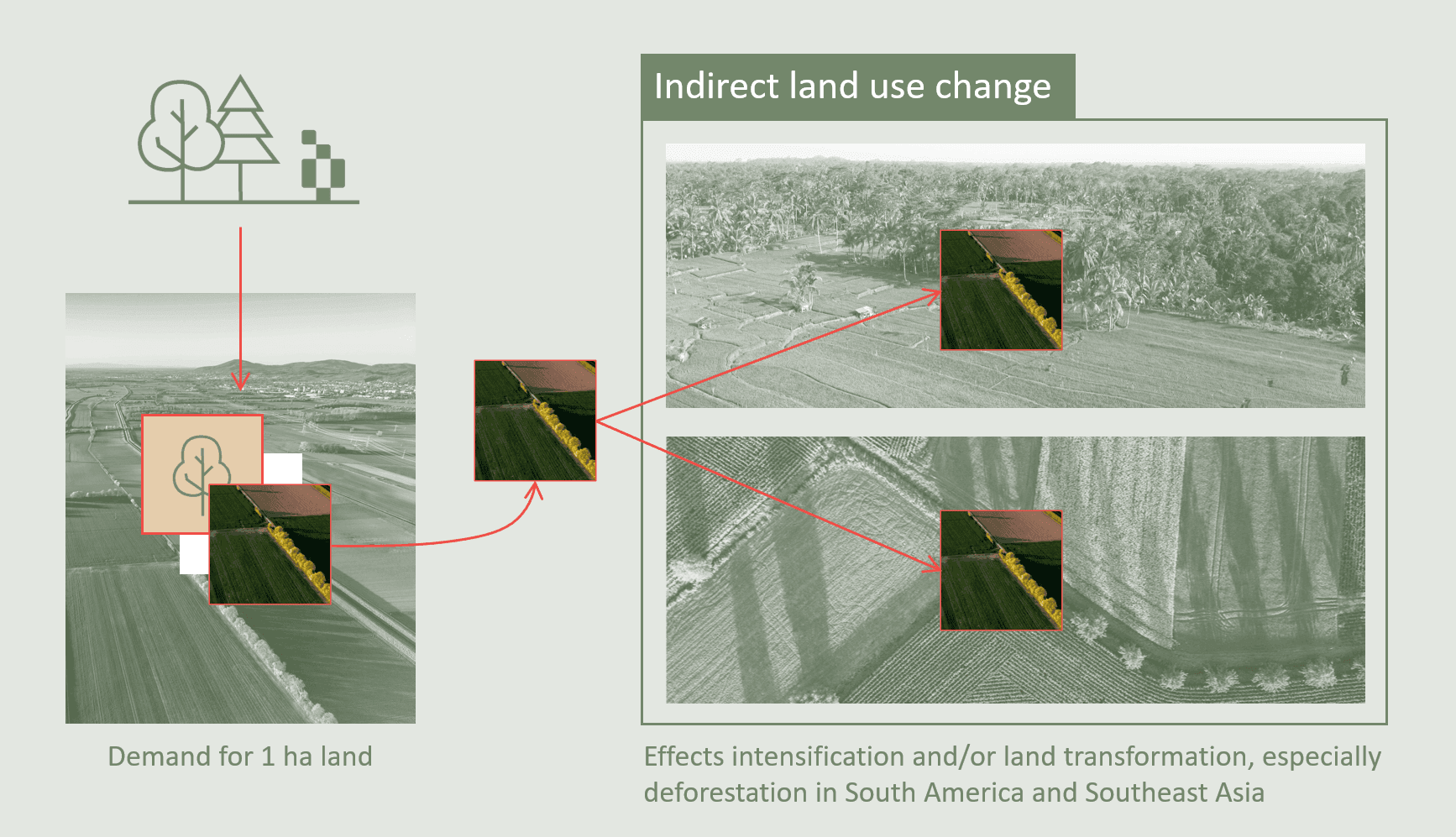
Low-impact biomass is a different story. This refers to residues, which are not fully utilised, and which would have been left for decay if not used for energy purposes. This kind of biomass does not require additional land use and therefore it is not associated with iLUC.
However, there is still an impact in terms of the timing of the CO2 when burning the biomass compared to the counterfactual, i.e. if the residues were left for decay, which may take several years. Here the impact from using the residues is preponed CO2 emissions compared to the CO₂ release with the slower process of natural decomposition. The impact from this type of biomass is much lower compared to biomass that requires land.
It should be noted that low-impact biomass is a scarce and very limited resource – keep on reading below.
It is important to emphasize that to have a "low-impact" biomass, it requires that the alternative use of it would be natural decomposition. Most forest residues and residual streams from other industries, such as bark and sawdust from sawmills, are already fully utilised today. When diverting an already fully utilised residue for biomass purposes, it will taken away from current users, who have to source the material from elsewhere: production of high-impact biomass elsewhere.
This is the part that usually gets missed, and it matters most. Even if you decide to use only "waste" as fuel, such as forest residues or sawdust from sawmills, you most often end up driving demand for the high impact biomass.
The reason is that many biomass residues are already fully utilised by other industries and the amount of sawdust available does not depend on demand for sawdust but rather the demand for sawn wood.
So, when an energy company buys a pile of sawdust that someone else was already using, this other consumer must source their biomass from alternative sources. On the margin, this can only be met by biomass which is able to increase their production to match demand, which means a return to the high-impact biomass that causes indirect land use changes. In other words, your biomass residue purchase quietly pushes another user towards high-impact biomass. This is leakage, and it means that "we only use waste or residues" is not a guarantee on its own.
Thus, understanding counterfactuals and market dynamics is key to ensure that biomass remains low impact. To avoid these leakage effects, one must identify sources of biomass residues that are not fully utilised. These represent a resource with great potential for the energy sector, since they can be used to replace fossil fuels while at the same time avoiding pushing another consumer towards high impact biomass.
Read an example of potential assessment of biofuel feedstocks here.
From a life-cycle perspective, biomass is not a single, uniform category with a single climate impact. Its overall effect depends entirely on its origin and on what its use displaces in the broader economy.
The most accurate conclusion is that biomass cannot be considered climate-neutral, it exists on a spectrum ranging from high to low impact, and that the availability of low-impact biomass is limited. Residual biomass streams may have the potential to be lower impact than dedicated energy crops, but this advantage only holds if robust safeguards ensuring that the alternative use will be natural decomposition are in place to prevent indirect increases in demand for higher-impact biomass elsewhere.
A proper understanding of the complexity of global supply chains is essential for assessing the real consequences of energy policy decisions. Given the urgency of climate change, there is little room for policy choices that fail to account for these system-wide effects.
Some of our clients that produce palm oil with the lowest environmental footprints, now give up on the European market and divert their production to the Asian market, currently much less restrictive in terms of environmental performances. This means that the previous achievements made by those companies may now be reverted, to compete in a more aggressive market with lower environmental requirements.
Although some RSPO certified producers of palm oil have already halved their carbon footprint and have set aside land for nature conservation, significantly reducing the impact on biodiversity in addition to reducing the carbon footprint, so that the best-in-class producers achieve a lower footprint than for other vegetable oils (such as rapeseed oil, soybean oil and sunflower oil), these efforts are not recognised by the new EU criteria for determining risk for indirect Land‐Use Change (iLUC).
In December 2018, the revised version of the EU Renewable Energy Directive, known as RED II (‘RED two’), entered into force. In March 2019, the European Commission published a Delegated Regulation supplementing the Directive by introducing criteria for the determination of high and low indirect Land‐Use Change (iLUC) risk associated with the expansion of feedstock production in land with high carbon stock.
The Delegated Regulation identifies iLUC risk based on the past direct land use change from 2008 onwards, regardless of the production system currently implemented, ignoring the geographical differences between producers and, de facto, disregarding the indirect nature of iLUC. The criteria do not trace the cause‐effect relationship between product demand and the indirect land use changes triggered. By not making any distinction between specific production systems, these criteria risk to exclude crops a priori, regardless of the environmental performance of the agricultural system, such as the GHG emissions per unit of product.
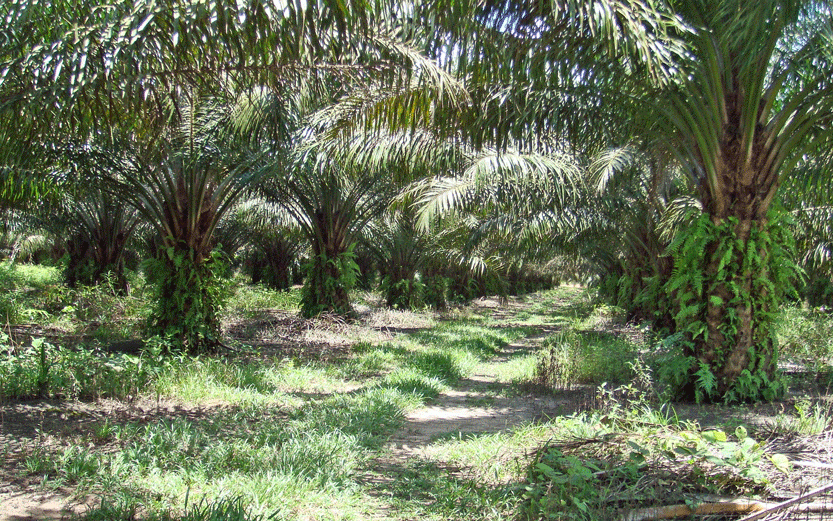
Palm oil is produced almost entirely (85%) in Indonesia and Malaysia, countries that in the last 20 years have experienced high deforestation. According to the criteria set by the RED II and detailed by the Delegated Regulation, palm oil from these countries cannot be counted as renewable when measuring target-achievement on the share of renewable energy in EU countries, because of high iLUC risk. In its current form, the iLUC criteria are scientifically unjustifiable and seem to protect the EU vegetable oil producers rather than the environment. This is sad news for RSPO certified companies and a dangerous development for forest and wildlife conservation in Indonesia and Malaysia.
This year we celebrate more than 10 years of focussed research on Land Use Change (LUC) and indirect Land Use Change (iLUC). We do this with a free webinar on iLUC modelling for up to 100 people on November 15th.
Our first publications that included land use effect were about rapeseed and palm oil, and were part of my Ph.D. thesis: Life cycle assessment of rapeseed oil and palm oil from 2007. Ten years later, we are still developing the models and improving the framework for modelling indirect land use changes in life cycle assessment (eg. Schmidt et al. 2015; De Rosa et al. 2017).
Our own efforts have been largely channelled through the iLUC initiative, aka the iLUC Club. We began this project in 2011 and today the iLUC initiative has more than 20 universities and companies as members. We are grateful for their continued support to this important work on towards consistent methodology and modelling of iLUC in life cycle assessment.
De Rosa M, Odgaard M V, Staunstrup J K, Knudsen M T, Hermansen J E (2017). Identifying Land Use and Land-Use Changes (LULUC): A Global LULUC Matrix. Environ. Sci. Technol. 51(14):7954–7962 https://lca-net.com/p/2735
Schmidt J H, Weidema B P, Brandão M (2015). A framework for modelling indirect land use changes in life cycle assessment. Journal of Cleaner Production 99:230‑238 https://lca-net.com/p/1863