

Solutions



Services



At 2-0 LCA, we are committed to building high-quality life cycle assessment (LCA) databases. But building such databases is difficult. Production systems are complex, interconnected, and described through many different types of flows, such as mass, energy, and monetary flows.
These flows are usually collected from heterogeneous data sources that were not designed to validate each other. A physical production statistic may come from one reporting system, trade data from another, prices from a third, and emission factors from yet another. Each source may be useful on its own, but when they are combined into one database, inconsistencies can quickly appear. If these inconsistencies are not detected and resolved, the resulting LCA results risk becoming unrealistic or difficult to trust. This creates a need for systematic data validation and reconciliation that can detect inconsistencies, correct them transparently, and keep the database reliable as it grows.
This is, however, challenging, when inputs and outputs are described in different units, such as tonnes, megajoules, and euros. These flows cannot be validated simply by adding them together. A monetary input cannot be directly compared against a mass output. Without a structured way to connect these layers, many inconsistencies remain hidden.
To address this challenge, BONSAI uses a graph-based multi-layer balance framework. The framework starts from heterogeneous source data, such as supply-use tables, trade data, process inventories, emission inventories, and physical properties. These data are first mapped into a common graph structure.
In this graph, products, activities, emissions, and natural resources are represented as nodes, while flows between them are represented as edges. The structure is bipartite: objects such as products, emissions, and resources are connected to activities through flows, rather than directly to each other. Each flow is first represented in its own characterization layer, meaning the unit in which it is naturally observed or used in LCA. For example, steel may be represented in tonnes, heat in terajoules, and services in millions of euros.
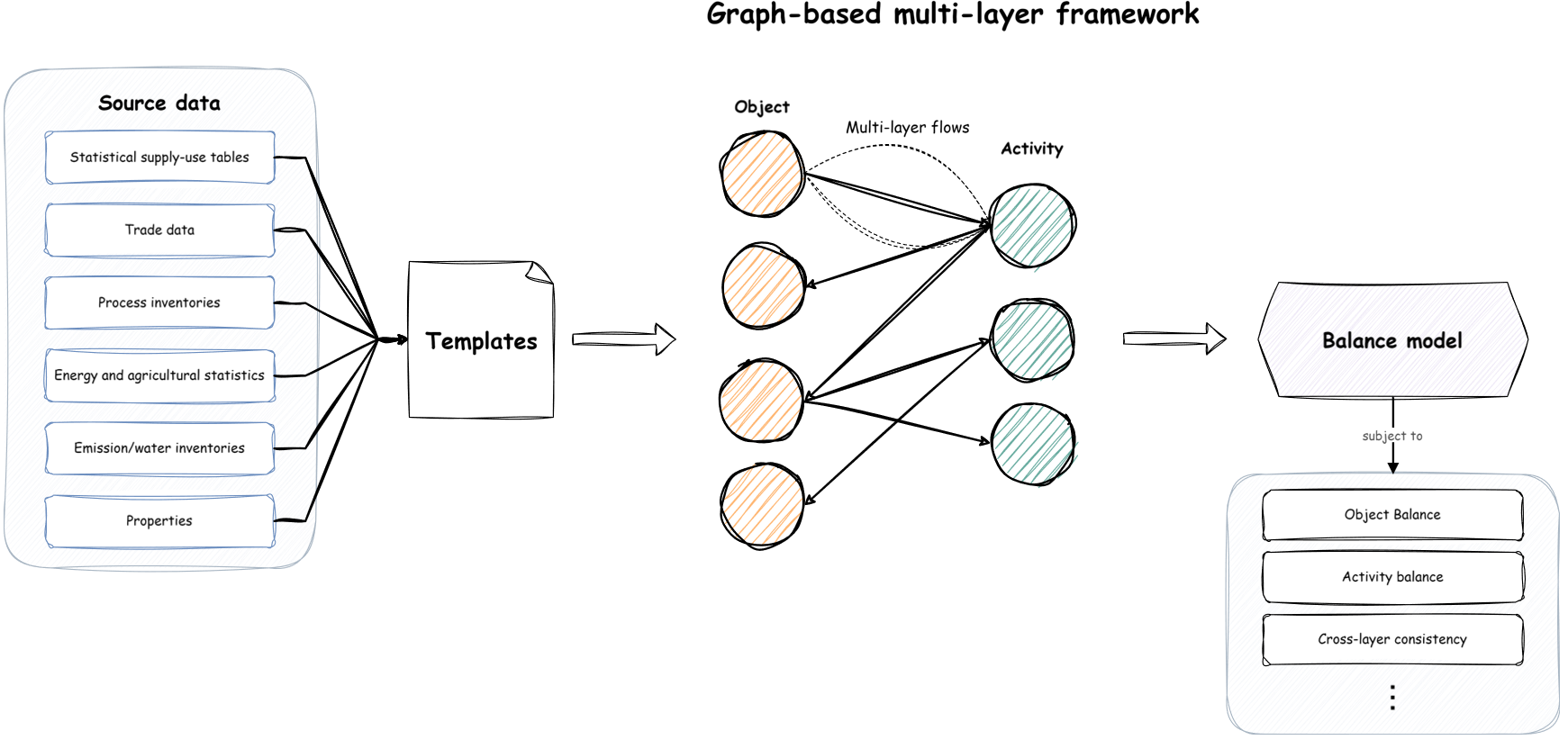
The key idea is that these layers are not treated as isolated systems. They are connected through conversion properties such as prices, densities, and energy contents. For example, a price can link a mass flow to a monetary flow, while an energy content can link a physical fuel flow to an energy layer.
This makes it possible to transform the same underlying flow into multiple representations. Flows within the same layer can then be aggregated, checked, and balanced, mass with mass, energy with energy, and monetary value with monetary value.
As a result, accounting principles that are normally applied to single-layer systems (such as EXIOBASE) can be extended to a multi-layer system. BONSAI can check whether products are fully supplied and used, whether activities remain economically and physically consistent, and whether cross-layer relationships are plausible, without mixing incompatible units or double-counting the same flow.
After reconciliation and validation, the multi-layer system can also be simplified for specific applications. Depending on the purpose of the database or model, selected layers can be retained or dropped. In this way, the framework supports both detailed multi-layer quality control and practical single-layer or mixed-layer representations for downstream LCA calculations.
In summary, the framework rests on three interlinked design choices.
Together, these design choices allow BONSAI to combine heterogeneous data sources into a database that is not only detailed, but also internally consistent and flexible enough to support different analytical applications.


