


A prospective environmental life cycle assessment (LCA) and financial cost assessment is performed to the application of bioaugmentation to sand filters in Danish waterworks, to remove 2,6-dichlorobenzamide (BAM) from drinking water resources. Based on pilot-scale and laboratory-scale data, we compare bioaugmentation to current alternative strategies, namely granular activated carbon (GAC) adsorption, and well re-location. Both assessments identified well re-location as the least preferred option, however, this result is very sensitive to the distance from the waterworks to the new well. When bioaugmentation is compared to GAC, the former has a lower impact in 13 impact categories, but if immobilized bacteria are used, the impacts are higher than for GAC in all impact categories. On the other hand, from a cost perspective bioaugmentation appears to be preferable to GAC only if immobilized bacteria are used.
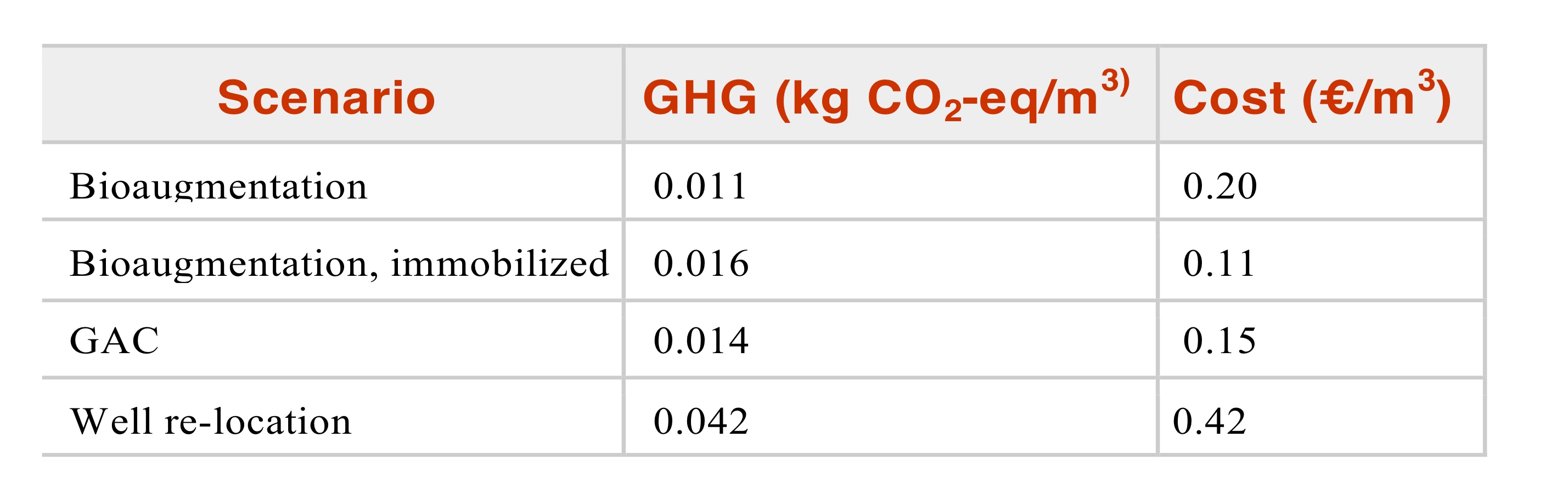
Table: Summary of Costs and greenhouse-gas (GHG) emissions for the four scenarios assessed for a waterworks producing 800,000 m3/year.
This prospective assessment examines bioaugmentation in sand filters to remove BAM from Danish groundwater. It compares the treatment with granular activated carbon (GAC) adsorption and well relocation, using pilot-scale and laboratory-scale data. Environmental life cycle impacts and financial costs are considered together. The accompanying table frames the results around a waterworks producing 800,000 m³ of drinking water per year.
The findings depend on the treatment setup: immobilising bacteria changes the environmental comparison with GAC, while the economic comparison gives a different result. The result for well relocation is also sensitive to the distance to the replacement well. These findings should be considered alongside local treatment design, distances and waterworks data.








