

We performed the LCA, put through a critical review by 3 external experts following ISO 14040/44 standard.
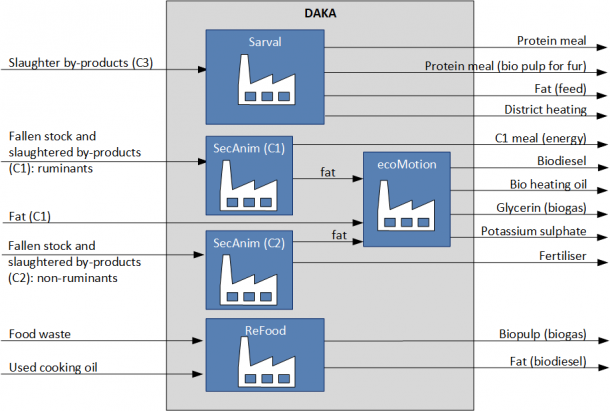
This project entails a detailed comparative cradle-to-grave life cycle assessment (LCA) of individual product portfolios and production lines for recycling of organic residues at DAKA.
The life cycle framework allows for a quantitative assessment of the environmental impact associated with all stages of a product’s life. In the current project the product portfolios under study are DAKA’s treatment services of C3 slaughter by-product, C1 and C2 slaughter by-products and fallen stock and food waste.
For all portfolios the environmental impact of DAKA’s treatment of different slaughter by-products and organic residues are calculated. For C3 slaughter by-products, a comparison with energy production (biogas) is also performed. The purpose of analysing all product portfolios is to gain a complete overview of DAKA’s total annual environmental impact.
The project follows the requirements in the international standards for LCA: ISO 14040 (2006) and 14044 (2006). The LCA has been subject to a critical panel review in accordance with the ISO standards on LCA. The study covers a wide range of environmental impacts, including greenhouse gas (GHG) emissions, i.e. carbon footprint, nature occupation, respiratory effects, eutrophication etc. The LCA also addresses indirect land use changes (iLUC).