Solutions



Services





By Jesper Dalgaard Pøhler, Client & Relations Manager at 2-0 LCA
At 2-0 LCA we focus on data all the time. Are they solid? Which conclusions can be drawn from the data – and which cannot? And most important: How could they make the world more sustainable? This month, we celebrate the pleasure of having worked together with Stefano Merciai for 15 years. Therefore, we asked him how the sustainability agenda has changed during the time, and what he expects of the future, which seems dark for the time being. Luckily, he is optimistic yet concerned:
“In its essence, sustainability is a way to live in harmony with all the things around us. But we cannot afford wasting valuable materials at the pace we do it now”, Stefano explains as he stresses the importance of improving sustainability data and databases.
Stefano has a background in statistics. Many of his fellow students went to the insurance or bank sector, but he wanted to do something that had a social impact and saw that the area of sustainability needed some attention.
“I have always wanted to work with something that has a social impact and is not destroying our planet, and when I fully realised the interconnection between environment and the social sphere, I moved to sustainability. Sustainability is so important to our daily lives, and I saw an opportunity to apply statistics to that field”, says Stefano.
“What if we scale up this concept to the majority of the population ... can we produce all these environmental-friendly materials in a sustainable way?”
- Stefano Mercai
One good example of the importance of statistics is houses. We all need them, and we all use them. We all want to live in a big independent house with a garden, perhaps paved so it is easier to deal with.
“And then you might think that we just need to use more environmental-friendly materials, make thicker walls and windows, and our dreams are possible. But what if we scale up this concept to the majority of the population? What is the impact on the land use, on the food production, on biodiversity? Further, can we produce all these environmental-friendly materials in a sustainable way? To answer these questions, we need a good quantitative analysis”, Stefano explains.
Therefore, the actually sustainable solution might sometimes seem counter-intuitive to the obvious one. In the case of houses, it could be that a concrete building is more sustainable than a series of independent houses.
“A quantitative approach helps choosing the more sustainable solutions. Without a good quantitative analysis, we might just speculate on unknown foundations. And of course, a quantitative analysis should be done together with social and economic analyses before choosing the desired solution”, Stefano elaborates.
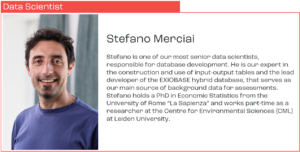
At 2-0 LCA, Stefano Merciai has played a key role in developing the EXIOBASE database, and recently the BONSAI database.
“In the beginning, we started experimenting with building a database to solve a specific problem: We needed waste accounts. The database quickly proved itself very useful, though, and so began the work on EXIOBASE hybrid. Today, we possess substantial knowledge of how to utilise these tools for several sustainability analyses”, says Stefano.
EXIOBASE hybrid is a database showing emissions for products and services from all over the world, and it is now used by multiple companies and organisations especially in Europe. It is a so-called ‘whole-system’ database, meaning that the whole global system is taken into account, whenever users ask for the emission account of a specific product.
“In that way, you ensure that nothing is counted twice and that you can actually compare emissions of different products, whether it is in kilos, Euros, or items or whatever”, Stefano explains.
He has experienced one too many times wasting time on collecting data that other people had already collected or seeing companies making decisions based on poor data. Therefore, he is proud of taking part in the development of the new BONSAI database, which is completely open-source, free to use, and based on the same principles as EXIOBASE, but with a much more flexible setup.
“Today, information is gold. Therefore, data are often hidden to the public.”
- Stefano Mercai
“The goal of BONSAI is to make a reliable database where people can provide and retrieve data. With a solid database as a starting point, we can spend more time on the analytic part, developing effective solutions for the companies that need to take the tough decisions about how to improve their work on sustainability in a way that makes economic sense too”, says Stefano and closes:
“Today, information is gold. Therefore, data are often hidden to the public. But with BONSAI we make good data available to more people and companies to pave the way for finding global solutions on the many challenges from the sustainability agenda. That is one of those things that keep me engaged at work”.
We salute Stefano and are happy that he will stay for another 15 years … hopefully.